The AI Employee Course, Part 3 of 10.
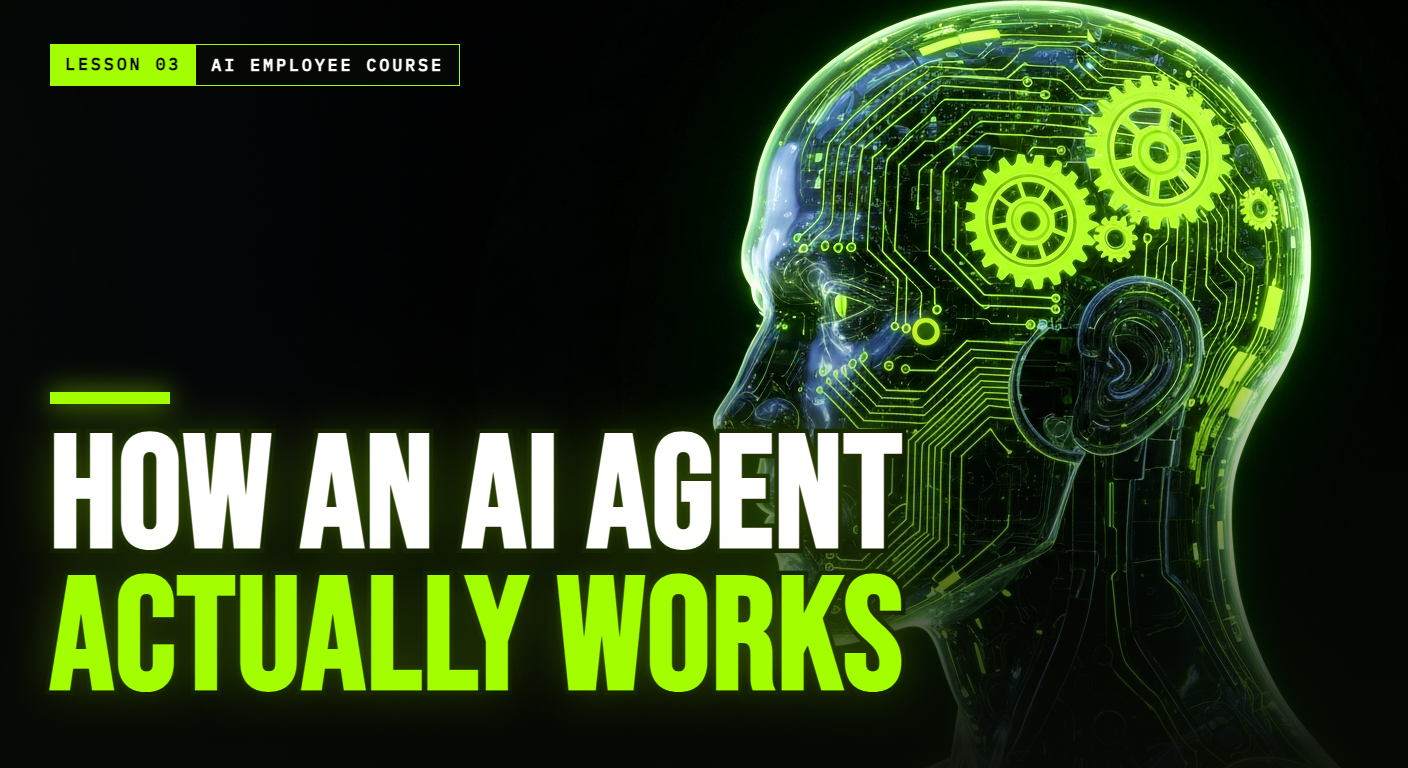
TL;DR: Every AI agent runs the same loop: it perceives what is happening, decides what to do next, and acts using its tools, then feeds the result back and repeats until the goal is met. That loop, plus memory and guardrails, is what separates an agent from a chatbot that only replies once.
You do not need to be technical to use an AI agent, but understanding the one loop it runs makes it far less mysterious and far easier to trust with real work. It is simpler than it sounds, and it is the same loop whether the agent is booking a meeting or running your whole inbox.
The loop: perceive, decide, act
An agent works in a cycle, the same way a person handling a task does.
- Perceive. It takes in the situation: a new message, a form submission, a calendar event, or a rule you set ("follow up if a lead goes quiet for two days").
- Decide. It reasons about the goal and picks the next step. Not from a fixed script, but based on what is actually happening right now. Researchers call this "reasoning and acting," and it is why an agent can handle a situation it was never explicitly programmed for.
- Act. It uses a tool to do something real: send a WhatsApp message, create a calendar event, update a CRM record, make a call.
Then it loops. It perceives the result of its action, decides the next step, and acts again, until the job is done. A chatbot does one lap and stops. An agent keeps going until the goal is met or it hits a limit you set.

What makes the loop smart: memory, tools, and planning
Three things turn that loop from a toy into a worker.
Memory, in two flavors. Short-term memory holds the current task ("this lead asked about pricing, I offered a call"). Long-term memory holds your business over time ("this customer always books on Mondays, we do not discount"). A chatbot has neither once you close the tab. An agent uses both, which is why it feels like it has been on your team for a while.
Tools. A tool is any action the agent is allowed to take: "send email," "book meeting," "look up a contact," "charge a card." The model chooses which tool to use; the tools are what let it touch the real world. The set of tools you grant is, quite literally, its job description.
Planning. For anything multi-step, a good agent breaks a goal into a sequence ("qualify, then book, then confirm, then log") and adjusts the plan as reality pushes back. That planning ability is the difference between "send one email" and "own the whole follow-up."
A real example of the loop
Say a new lead messages your business at 11pm asking about pricing.
- Perceive: the agent sees the WhatsApp message arrive.
- Decide: the goal is to qualify and book. First step: answer the pricing question and ask two qualifying questions.
- Act: it replies in seconds.
- Perceive: the lead answers, and they are a good fit.
- Decide: next step, offer a call.
- Act: it shares your calendar, the lead picks a time, the agent books it and logs the contact.
No human was awake. The loop ran to completion. That is the whole idea.
Guardrails: where humans stay in the loop
Autonomy does not mean "no oversight." Good agents run inside guardrails you define, and this is what makes them safe to trust.
- Approval gates. Certain actions (refunds, big sends, anything irreversible) pause and wait for your yes.
- Limits. Spend caps, message caps, and "never do X" rules the agent cannot cross.
- Escalation. When it is unsure or hits something outside its comfort zone, it stops and hands the situation to you, with context, instead of guessing.
You decide how much rope to give it, and you widen the guardrails as trust grows. A well-built agent fails safe: when in doubt, it asks.
Frequently Asked Questions
Does an AI agent think like a human? Not really. It runs a reasoning loop, perceive, decide, act, powered by a language model. It is very good at handling messy, real-world steps that a rigid automation can't, but it is following a goal you set, inside limits you set, not forming its own intentions.
What happens if the agent does not know what to do? A well-built agent asks, or escalates to you, instead of guessing. You can configure it to pause and request approval whenever it hits something outside its comfort zone, so it fails safe rather than doing the wrong thing.
How is this different from a chatbot flow? A chatbot follows a fixed decision tree and breaks when the conversation goes off-path. An agent decides each step live, based on what is actually happening, and can re-plan mid-task, so it adapts instead of dead-ending.
Part 3 of the AI Employee Course. Next, Lesson 4: why old-style automation (Zapier, Make) breaks where an agent keeps going.
P.S. BOB runs this loop for real businesses every day, inside WhatsApp. Meet BOB.