The AI Employee Course, Part 1 of 10.
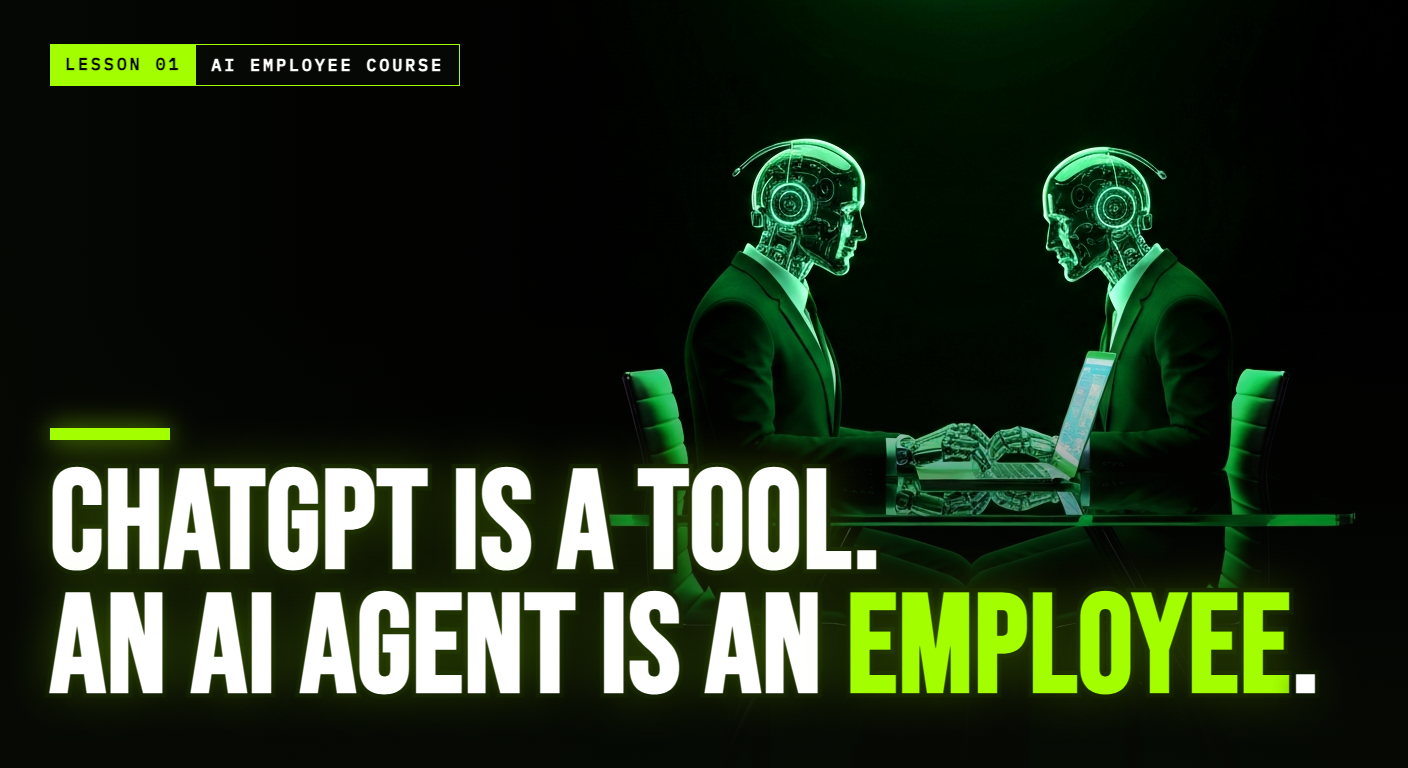
TL;DR: Chat AIs like ChatGPT, Claude, and Gemini are tools you operate: you ask, they answer, and the work is still yours to finish. An AI agent is different. It takes a goal, makes its own decisions, and carries the task to done across your real systems. One talks. The other works.
You have probably spent the last year asking a chat AI, ChatGPT, Claude, or Gemini, to write emails, draft posts, and answer questions. They are genuinely useful. But you have also hit the ceiling: they tell you what to do, and then you still have to go do it. That gap, between "here is the answer" and "the job is done," is the whole story of AI right now, and it is the reason a new category, the AI agent, exists.
What actually separates an AI agent from a chat AI?
An AI agent does not just answer, it acts. It reads a situation, decides the next step, and executes across your tools until the goal is met. A chat AI waits for your next prompt and hands you text. An agent takes a goal and comes back with a result.
The difference is not the intelligence of the model. An agent usually runs on the exact same brains, Claude, GPT, or Gemini, that power the chat tools you already use. The difference is what surrounds that brain: memory, tools, and permission to act. A chat AI is the brain alone. An agent is the brain plus a body.
| Chat AI (ChatGPT, Claude, Gemini) | An AI agent |
|---|---|
| Waits for you to prompt it | Starts and continues work on its own |
| Gives you text and advice | Takes actions across your systems |
| Forgets between chats | Remembers your business over time |
| Lives in one chat window | Reaches you on WhatsApp, email, and phone |
| Hands back raw material | Comes back with the job done |
The anatomy of an agent: four parts, not one
If a chat AI is just a model, an agent is four things working together. Understanding them makes the whole category click, and makes it obvious why an agent can do things a chat window never will.
- The model (the brain). The reasoning engine: Claude, GPT, or Gemini. It decides what to do. On its own, it can only produce text.
- Memory. A store of what matters: your business, your customers, past conversations, the decision you made last week. This is what lets an agent act with context instead of starting cold every time.
- Tools. The actions it is allowed to take: send an email, book a meeting, update a CRM, charge a card. Tools are the hands. Without them, the smartest model can still only talk.
- The loop (orchestration). The part that runs the model again and again, feeding it the result of each action so it can decide the next step, until the goal is done. This is what turns a single answer into completed work.
Take any one of those away and you are back to a chat window. Put them together and you have something that behaves like an employee.
Levels of autonomy: it is a dial, not a switch
"AI agent" is not one setting. It is a spectrum of how much you hand over, and you control where on the dial it sits.
- Assistant. It drafts, you send. Every action needs your click. Good for high-stakes tasks or early trust.
- Copilot. It does the work and asks approval only on the sensitive parts: a refund, a discount, a big send. Most businesses live here.
- Autonomous. It runs entire workflows end to end and only escalates the exceptions. Reserved for the routine, well-understood tasks where it has earned trust.
You do not have to jump to full autonomy. The smart move is to start as an assistant, watch, and turn the dial up one task at a time as it proves itself. Lesson 10 is the practical playbook for exactly that.
So are chat AIs obsolete? No, and here is when to use each.
No. A chat AI is the right tool when you want to think, draft, brainstorm, or explore an idea with a smart partner. An agent is right when a task needs to get done reliably and repeatedly without you in the loop. One is a brilliant assistant you drive. The other is a worker you delegate to.
Most businesses will use both, often powered by the same underlying model. You keep a chat tool open for thinking. And you hand the recurring, repetitive, easy-to-drop work to an agent, the same way you would hand it to a junior hire, except this one works around the clock and replies in seconds.
Frequently Asked Questions
Is an AI agent just ChatGPT or Claude with extra steps? Close, but the "extra steps" are the whole point. A chat AI generates text when prompted. An agent uses that same kind of model as its brain, then adds memory, tools, and permission to act, so it completes tasks across your systems instead of describing them.
Does the agent use a different AI than ChatGPT or Claude? Usually the same ones. Most agents run on the leading models (Claude, GPT, Gemini) under the hood. What makes it an agent is not a smarter brain, it is the memory, tools, and autonomy wrapped around that brain.
Will an AI agent replace my team? It replaces tasks, not people. An agent is best at the repetitive, after-hours, easy-to-forget work: follow-ups, scheduling, reminders, data entry. That frees your team for the judgment, relationships, and creative work that actually needs a human.
This is Part 1 of the AI Employee Course, a 10-part, plain-English guide to AI agents and how they really work. Next, Lesson 2: what OpenClaw is, and why the engine behind AI employees is open source.
P.S. Want to see an AI employee already doing this? BOB runs on the open-source OpenClaw engine and lives in your WhatsApp. Meet BOB.