The AI Employee Course, Part 4 of 10.
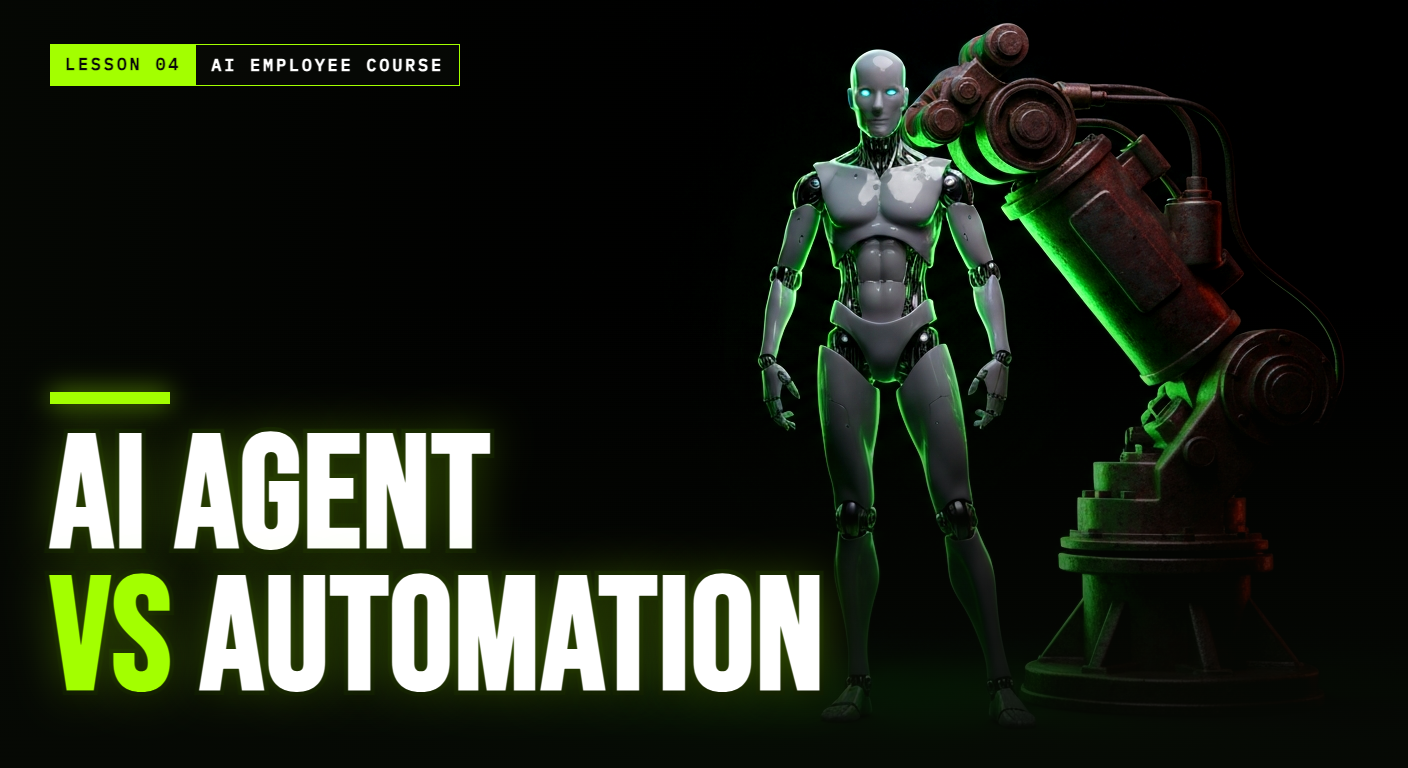
TL;DR: Automation tools like Zapier and Make follow a fixed script: "when X happens, do Y." They are great until reality goes off-script, then they break. An AI agent decides each step based on what is actually happening, so it handles the messy, in-between cases that break a rigid workflow. Most businesses end up using both.
If you have used Zapier or Make, you already understand automation: connect two apps, set a trigger, set an action. It is powerful and it is not going away. But there is a hard ceiling, and it is worth knowing exactly where it is before you build your business on it, because the ceiling is the exact place agents begin.
Deterministic vs. probabilistic: the real dividing line
Here is the core idea in one sentence. Automation is deterministic: same input, same output, every time. An agent is probabilistic: it reasons about the situation and decides, so it can handle inputs you never anticipated.
That distinction cuts both ways. Deterministic is a feature when the task is simple and you want it to run identically forever ("when an invoice is paid, add a row to the sheet"). It is a bug when the task involves judgment, because the moment reality does not match the script, the automation either does the wrong thing or nothing at all.
| Automation (Zapier, Make) | AI agent |
|---|---|
| Follows a fixed script you build | Decides each step toward a goal |
| One trigger, one action | Handles a whole multi-step task |
| Breaks when reality goes off-path | Adapts and re-plans |
| Same input, same output, always | Reasons about the specific situation |
| You maintain every rule | You set the goal, it works out the steps |

A side-by-side example
A lead replies to your outreach: "Interested, but can you do next week instead?"
- The automation was built to book the originally offered slot. This reply does not match its trigger. It stalls, books the wrong time, or drops the lead into a folder you will check on Friday.
- The agent reads the reply, understands "next week," checks your calendar, offers three real times, books the one they pick, and updates the record. No new rule required.
That gap, the ability to handle the reply you did not script for, is the entire reason agents exist. Every "edge case" that would need a new Zap is just a normal Tuesday for an agent.
The smartest setups use both
This is not a war, and treating it as one costs you money. The best architectures are hybrid:
- Automation for the plumbing. High-volume, predictable, one-step tasks (sync this to that, log every payment) are cheaper and more reliable as a plain automation. You want those boring and deterministic.
- Agents for the judgment. Conversations, follow-ups, qualification, anything with a human on the other end, go to the agent.
- They trigger each other. A common pattern: an automation catches an event and hands it to the agent to handle the messy part, then the agent calls an automation to do the clean final step. Each does what it is best at.
A simple rule for deciding
When you are not sure which to use, ask one question: does this task have a single, predictable path, or does it depend on what a human says or does?
If the path is fixed, automate it. If it depends on a reply, a judgment, or a situation you cannot fully predict, give it to an agent. Most owners start by moving their most-broken Zaps, the ones that keep failing because reality is messier than the rule, over to an agent, and keep the reliable ones exactly where they are.
Frequently Asked Questions
Is an AI agent just a smarter Zapier? Not exactly. Zapier connects apps with fixed rules. An agent uses an AI model to decide what to do at each step, so it handles open-ended, conversational tasks that no fixed rule can cover. They solve different problems and work best together.
Can an AI agent replace all my Zaps? It can replace the ones that keep breaking because reality is messier than the rule. Keep simple, reliable one-step automations. Move the judgment-heavy, multi-step work to an agent, and let the two hand off to each other.
Which is cheaper? For a single predictable action, automation is usually cheaper per run. For a whole task that would otherwise need a person (qualifying, replying, booking, following up), an agent is far cheaper than the hours it saves.
Part 4 of the AI Employee Course. Next, Lesson 5: 20 concrete jobs an AI agent does that a chat AI simply can't.
P.S. BOB handles the messy, off-script customer work automation can't. Meet BOB.