The AI Employee Course, Part 8 of 10.
TL;DR: What makes an AI agent feel like a real team member is not just intelligence, it is identity: its own name, email address, phone number, and a memory of your business. Those turn a clever tool into someone your customers and team can actually work with, and they are also where security and trust get real.
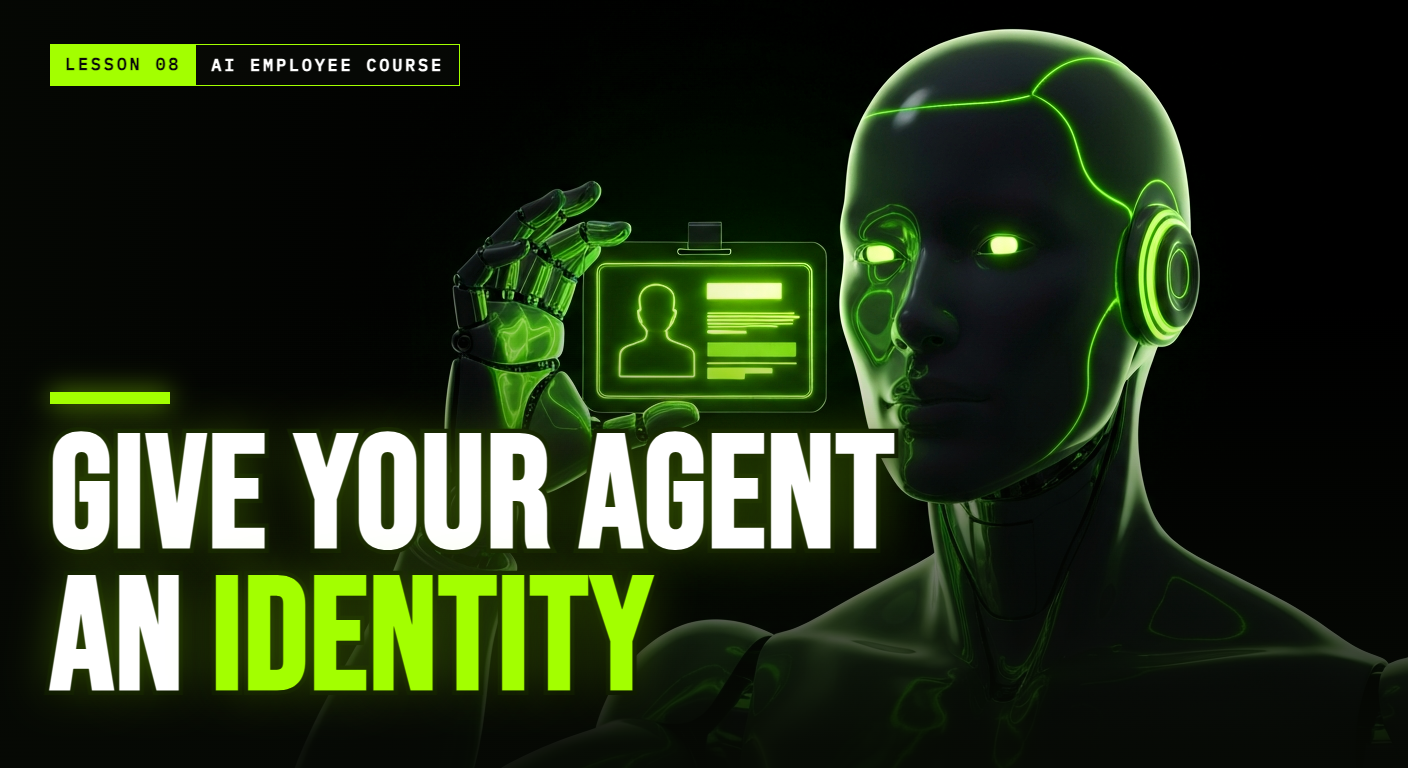
There is a moment when an AI stops feeling like software and starts feeling like a colleague. It is not when it gets smarter. It is when it gets an identity, the same handful of things that make a new hire real on day one. A chat AI has none of these. An AI employee needs all of them.
Why identity, not just intelligence, matters
A brain with no name, no inbox, and no memory can only ever be a tool you open. Give it those things and it can operate in the world:
- A name your team and customers refer to, so "ask the assistant" becomes "ask Alex."
- Its own email address, so it can send, receive, and be CC'd like anyone else.
- Its own phone number, so it can text and call from a real line, not your personal one.
- Persistent memory, so it knows your business, your customers, and last week's context.
None of these make the model smarter. All of them make it usable as an employee instead of a feature.

Memory is the part people underestimate
Identity without memory is a costume. The reason a good agent feels like it has been on your team for months is that it remembers: who your regulars are, how you phrase things, what you decided last time, which supplier you use. A chatbot resets every conversation. An employee builds context. Memory is what moves an agent from a tool to a teammate.
This is also what makes it get better over time. The longer it works with you, the more it knows, and the less you have to explain, exactly like a human hire past their first month. A brand-new agent is a capable temp. A six-month agent is a trusted one, purely because of memory.
The security view: an agent is a non-human identity
Here is the part most guides skip, and the part that actually matters as you give an agent more power. In security terms, an AI employee is a non-human identity, an account that can log in and act, just like a person's. That means it should be governed like one.
- Least privilege. Give it access only to the tools and data it needs for its job, nothing more. A receptionist agent does not need your bank login.
- Scoped, revocable access. Every connection is a permission you granted and can pull back instantly, not a shared password.
- An audit trail. You should be able to see what it did and when, the same way you would review any employee's work.
Handled this way, an agent is safer than the sticky-note passwords and shared logins most small businesses actually run on.
A real seat at the table
The frontier of this idea is letting an agent transact: its own scoped payment method for the small operational purchases it is allowed to make, within limits you set. That is not science fiction, it is where identity leads. An employee you fully trust does not need you for every ten-dollar decision. An agent with a capped budget and clear rules can handle the small stuff and leave you the judgment calls. The goal is an employee you trust with the routine, not a loose cannon with your credit card, and that is entirely a matter of the boundaries you set.
Frequently Asked Questions
Why would an AI agent need its own email and phone? So it can operate like a real team member: send and receive on its own address, text and call from a real number, and be contacted directly, instead of borrowing yours. It keeps your personal accounts separate and lets the agent work independently.
Does giving an agent memory risk my privacy? Memory is what makes it useful, and safe memory is a matter of where the data lives and who can see it. Ask any provider how memory is stored and secured. Done right, it is your business's context working for you, not exposed.
Should an AI agent really have a payment method? Only with tight, explicit limits. A scoped, capped budget for small, pre-approved operational costs can save real time. Anything beyond the limits you set should still require your approval.
Part 8 of the AI Employee Course. Next, Lesson 9: how one agent connects to over 1,000 tools and works across your whole stack.
P.S. BOB comes with its own identity and a memory of your business, out of the box. Meet BOB.